.avif)

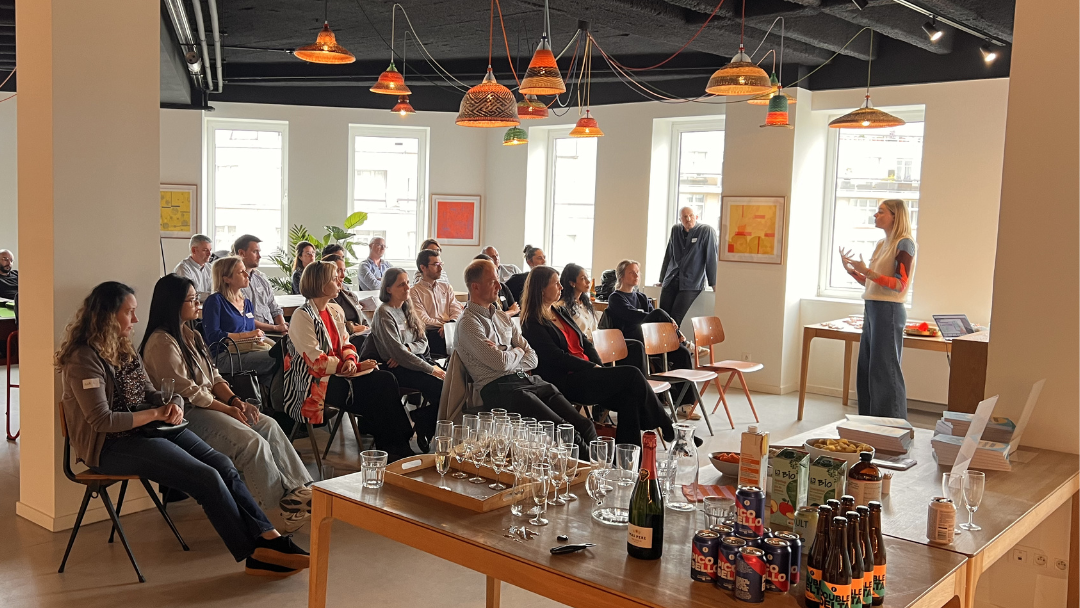
What really stops teams from engaging? Not in theory. Not according to a generic report. But within Belgian companies, on a daily basis, according to those living it from the inside.
In May 2026, eBloom gathered 35 executives and HRDs for a workshop-style afterwork. One of the exercises: each participant took on a role different from their own (employee, manager, or HR) and worked in groups to identify the obstacles to engagement specific to that role—and, more importantly, the solutions to overcome them. The result: insights that most would never have articulated from their own seats.
Before identifying obstacles and solutions, we must align on a fundamental question: what exactly do we mean by "engagement"? Satisfaction and engagement are two similar but distinct concepts, and the nuance deserves to be clearly defined.
A satisfied employee is "at peace": they don’t complain; they stay. They find their working conditions acceptable, their salary fair, and their environment comfortable. However, this peace doesn't necessarily drive them to go the extra mile. An engaged employee is active: they involve themselves, contribute beyond what is asked, and pull the organization forward. It is a state visible in the quality of work, the solidarity between colleagues, the ability to weather difficult periods, and in both individual and collective performance.
In Belgium, only 11% of employees reach this second state, placing the country 27th out of 38 in Europe (Gallup, 2026). It was this active engagement, rather than simple satisfaction, that guided the evening’s discussions.
Participants playing the "employee" role highlighted a barrier that data rarely captures easily: the weight of the past. "We tried that, and it didn't work." This seemingly mundane sentence encodes years of accumulated frustration—ideas expressed but never heard.
Added to this is the fear of how one is perceived. Speaking up means exposing oneself. This isn't cowardice; it’s a very human social calculation.
💡 The eBloom Tip : One of the most effective ways to lift this barrier in practice is to guarantee feedback anonymity. With Click&Bloom, employees answer short, regular questions in total confidentiality: no names, no individual data visible. What people would never say in a meeting, they eventually write down. And that is often where the real signals are found.
The group concluded that the employee is not a passive spectator of their own engagement; they are a full-fledged actor in it. It all starts with "daring to take the first small step": an idea expressed, a conversation initiated. What helps in taking that step is better self-knowledge, understanding one’s needs, values, and what truly matters, to express them clearly. On the organizational side, the equation is simple: when an employee sees their idea taken into account and receives concrete recognition from colleagues or management, the desire to get involved returns.
The manager stands at the crossroads of all tensions. Their role in engagement is massive: 70% of the variance in team engagement depends on the manager (Gallup, 2024). But to play this role fully, the structure must allow it.
The identified obstacles affect various types of organizations. In pyramidal structures, too many hierarchical levels stifle autonomy and lengthen decision-making cycles. In matrix organizations, it is clarity of roles that is lacking: when multiple reporting lines coexist, it isn't always clear who decides what. Added to this is availability: an overworked manager simply doesn't have the time to listen. When this lack of proximity persists, a fatalistic disengagement eventually sets in on both sides.
Concrete paths exist to address these points. Clarifying roles often involves a simple but rarely performed task: putting in writing who is responsible for what and ensuring everyone knows it. Regarding availability, integrating team management into a manager’s KPIs and associated recognition changes everything: what is measured gets done; what is recognized is repeated.
"We ask managers to create trust, but we don't give them the time to build the relationship."
However, levers do exist. Targeting the right managers during recruitment and promotion is perhaps the most structural decision: interpersonal skills matter as much as technical expertise. But identifying the right profiles isn't enough; they must be equipped. A manager who has never learned to conduct a feedback interview, detect weak signals in their team, or manage interpersonal tension is left alone in situations for which they have no tools. Training managers in the human realities of the role, not just management tools, is an investment that pays off directly in engagement. It is this combination (the right profile, well-trained and well-equipped) that allows the manager to do what no one else can: be present, embody clear direction, and create the conditions for everyone to dare to speak up and get involved.
Participants in the HR role expressed a central barrier: obtaining leadership support. Behind this barrier lie two recurring causes. The first: a lack of data to convince. To invest in engagement, one must first know how to quantify the cost of inaction. Yet, this calculation is rarely performed.
However, the consequences of disengagement are very real and measurable: absenteeism costs an average of €1,600/employee/year (SDWorx, 2024), 1 in 4 Belgian employees is actively looking for a new job (Acerta & Stepstone, 2025), and a recruitment via an agency costs approximately €15,000 (Jobat).
The second cause: engagement is too often viewed as the sole responsibility of HR. This isolates them and exhausts the initiative before it even takes flight.
Yet, the impact of a true engagement policy is documented: companies that invest in it see -81% absenteeism and -43% turnover among their most engaged employees (Gallup). These figures speak to any leadership team.
The role of HR is not to carry everything. It is to create the conditions for every level to take action. Launching pilot projects in a targeted department allows for demonstrating impact before scaling up and speaking in terms of results, not just intentions. Relying on peer exchanges between HR professionals helps with benchmarking and prevents isolation. Finally, investing in manager mentoring and giving them concrete levers allows HR to multiply their impact without carrying the weight alone.
Engagement is not a mysterious problem. The obstacles are known, nameable, and present at every level of the organization. What emerged from this workshop is not that everything is going wrong—it’s that everyone, at their level, has real room for maneuver.
The employee can dare to speak up. The manager can create the space for that to happen. HR can provide the tools and unite the forces to make it last. These three dynamics do not work without one another. When they align, engagement stops being a meeting topic and becomes a daily reality.
eBloom helps organizations create precisely these conditions by providing each level with the right tools at the right time.


Van de digitalisering van HR tot de integratie van AI en de nieuwe verwachtingen van medewerkers: de humanresourcessector is in volle verandering. Ons rapport, gebaseerd op de antwoorden van meer dan 450 Belgische bedrijven, geeft u een voorsprong om uw teams en strategie voor te bereiden op de realiteit van morgen.
.jpg)
.avif)

.avif)
.avif)



.avif)

.jpg)