.avif)

.png)
Long-term absenteeism is not inevitable; it is the symptom of a silence that weighs heavily on performance. In Belgium, burnout has become a structural threat. According to a study by Securex, one-third of Belgian workers operate in an environment where they do not dare to speak up freely.
The consequences of this lack of psychological safety are mathematical: for these employees, the risk of developing severe burnout symptoms is multiplied by three. For CHROs and CEOs, psychological safety is no longer a "fuzzy HR" concept—it is a leading indicator of organizational health that urgently needs to be monitored.
Burnout never happens by chance. It is the result of a prolonged imbalance between an individual's resources and the pressures they face. The Securex study demonstrates a direct link between a climate of trust and mental health:
The Securex study reveals an indisputable link: psychological safety is a full-fledged business metric. An environment where silence rules is not just toxic; it is economically inefficient.
Clearly, psychological insecurity acts as an invisible tax on your company's performance.
To counter rising absenteeism, surface-level perks like yoga classes or fruit baskets are not enough. Sustainable prevention relies on structural foundations: satisfying three core psychological needs, grouped under the ABC model:
When these needs are met, psychological safety settles in naturally. Conversely, their chronic frustration is the first step toward professional exhaustion.
The behavior of direct managers alone accounts for nearly 20% of how psychological safety is perceived at work. This is an immense responsibility. Yet, the Securex study shows a worrying shift in leadership behavior in Belgium: between 2021 and 2024, the number of leaders showing "controlling behavior" increased by 69%, while those adopting "supportive behavior" decreased by 22%.
This shift toward micro-management, often adopted as a reflex in times of economic uncertainty, is a direct catalyst for burnout. By over-controlling, managers break the right to make mistakes and stifle communication. Employees, fearing judgment, no longer dare to signal their overload. As Elisabeth Van Steendam (Securex) points out, leadership is a behavior that can be learned. Investing in manager coaching is no longer a "nice-to-have" option; it is a vital protective measure for the organization's mental health.
Micro-management does more than just stress teams; it directly attacks your capacity to innovate by creating a culture where mistakes are penalized rather than analyzed.
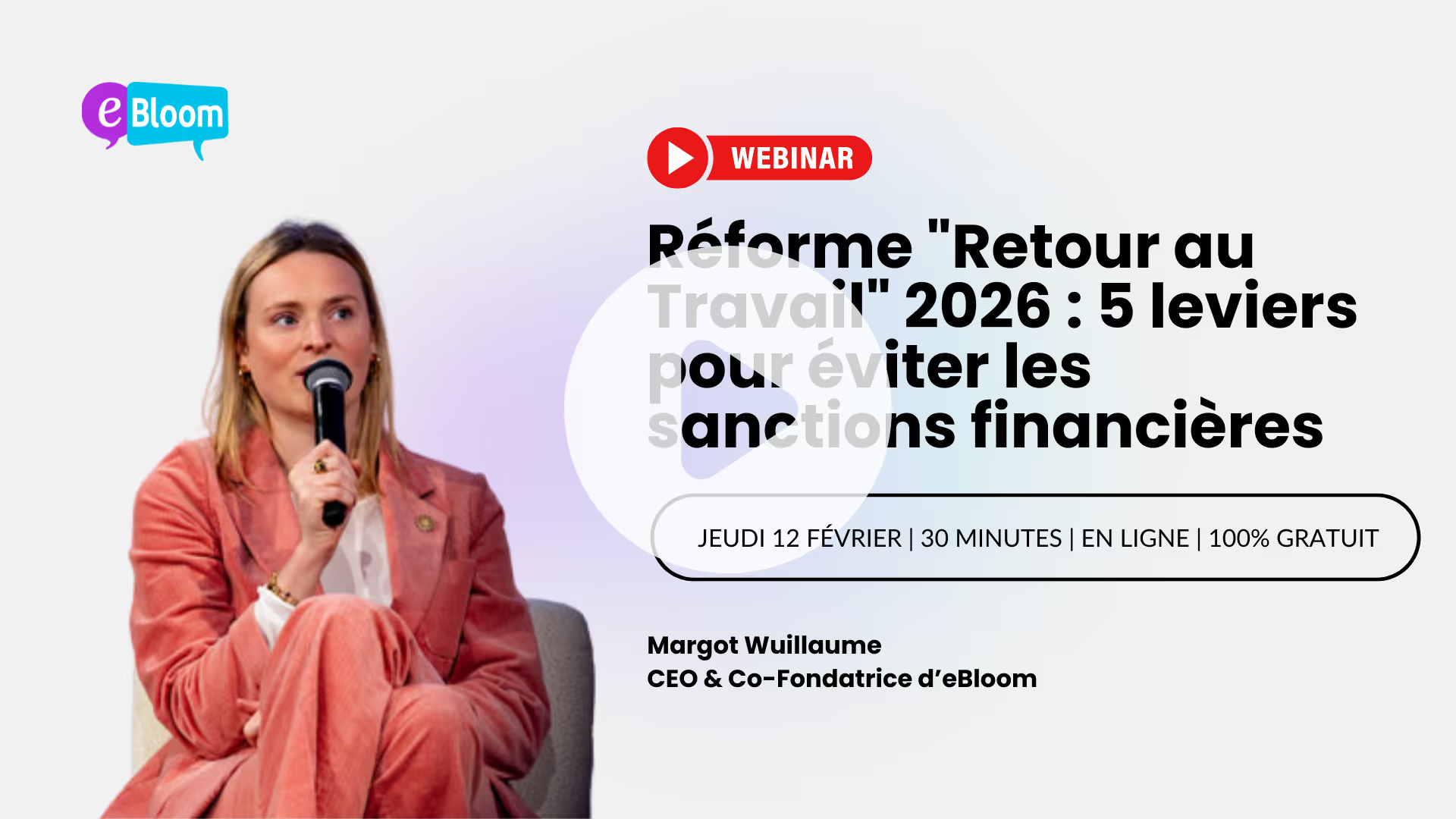
If the human aspect isn't enough to convince you, the Belgian legal framework will. Since January 1, 2026, the Return to Work Reform (Vandenbroucke Law) has reinforced the financial liability of employers.
From now on, companies with more than 50 employees must pay a solidarity contribution of 30% of the mutual insurance indemnity for workers on long-term sick leave. To put it clearly: every unprevented burnout becomes a direct, immediate line expense on your balance sheet. Psychological safety has become a matter of compliance as much as performance.
How do you find out what your teams don't dare to say out loud? This is where eBloom transforms human management by replacing passive surveys with a true steering tool.
In 2026, ignoring psychological safety is a luxury that Belgian companies can no longer afford. Protecting your employees' mental health means protecting your organization's resilience.
Would you like to measure the level of psychological safety within your teams? Book your eBloom demo today and discover how our AI Julia can help you prevent absenteeism before it's too late.


From HR digitalization to AI integration and new employee expectations, the human resources sector is rapidly changing. Based on responses from over 450 Belgian companies, our report gives you a head start to prepare your teams and strategy for the realities of tomorrow.
.jpg)
.avif)

.avif)



.avif)

.jpg)