
8 min.

Brownout: definition, symptoms and solutions for managers

What is brownout at work? Learn how it differs from burnout and boreout, the warning signs to watch for, and how managers can prevent it early.
Brownout: definition, symptoms and solutions for managers
Published on
October 21, 2026

A once-motivated employee now gets through their tasks without enthusiasm, almost on autopilot. It isn't laziness, nor a passing slump. It might be brownout.

Brownout is a form of work-related exhaustion caused by a loss of meaning at work. Unlike burnout, which drains people of their energy, brownout sets in when an employee no longer sees the point of their work, even though they keep doing it as usual.

The phenomenon is hard to quantify: unlike burnout, brownout has no recognised measurement tool yet. But the signs of disengagement are clearly there in Belgium: according to Great Place to Work's 2025 European Workforce Study, conducted with Vlerick Business School, only 54% of Belgian employees consider their organisation a great place to work, compared with a European average of 59%. Brownout is insidious and often goes unnoticed: the employee is still there and seemingly productive, which makes it harder to spot than burnout.

In this article, you'll learn what brownout really is, how it differs from burnout and boreout, and above all how to spot it in your teams before it leads to someone leaving.

What is brownout? Definition and origin of the term

The term "brownout" comes from the world of electricity. It refers to a drop in voltage in a power grid without a complete outage, unlike a "blackout", as explained in this Malakoff Humanis guide to brownout. Applied to the workplace, the image speaks for itself: the employee keeps running, but at reduced power.

In the workplace, the term was popularised in 2015 by Michael E. Kibler, an American consultant and researcher, in a Harvard Business Review article. He described "executive brownout": high-performing managers who, under silent and constant overload, gradually lose their passion for their work and disengage, with no visible crisis. Since then, the term has broadened to all employees and refocused on the loss of meaning.

In practice, brownout shows up as:

  • A gradual loss of meaning in day-to-day tasks
  • Silent disengagement, with no outburst or visible warning sign
  • Declining motivation that doesn't immediately affect apparent performance
  • A sense of mismatch between one's own values and those of the company

This last point is key: brownout often stems from a values misalignment, not from a lack of skill or effort.

Brownout, burnout, boreout: what's the difference?

All three syndromes relate to work-related exhaustion, but their causes and symptoms differ significantly. Confusing them means preventing them poorly.

Syndrome Main cause Symptoms Origin of the term
Burnout Poorly managed chronic work stress (overload, but also lack of recognition, values conflicts…) Intense exhaustion, cynicism and disillusionment with work, reduced effectiveness “To burn out”: to burn until extinguished
Boreout Too little work, boredom Lack of stimulation, low self-worth, effects similar to burnout “To bore”: to cause boredom
Brownout Loss of meaning, values misalignment Gradual, silent disengagement “Brownout”: a drop in electrical voltage

A common misconception: burnout isn't just about overload. According to the WHO definition, it combines exhaustion, a cynical distance from work and reduced effectiveness. Disillusionment is therefore part of it, and that's where the two syndromes overlap. The difference lies in exhaustion: in burnout, the person is drained of energy; in brownout, they're still holding on, but their work has lost its meaning.

An employee experiencing brownout may be just as busy as before, sometimes busier, sometimes less so: workload simply isn't the right indicator. What has broken down is their relationship with the meaning of their work, as highlighted in this Bpifrance report on brownout in the workplace.

Warning signs to look out for in an employee

Because it doesn't come with sudden exhaustion, brownout is particularly hard to detect. The signs are often masked by apparent professional normality.

Here are the signs that should alert a manager:

  • Mechanical task execution: the work gets done, but without real investment or attention to quality
  • Repeated questions about the purpose of tasks: "what's the real point of this?", "why are we doing this?"
  • Gradual withdrawal from informal exchanges: less participation in team discussions, less initiative
  • Less creativity and risk-taking, even though the workload remains stable
  • Comments about a gap between the company's values and the actual work required

The risk of doing nothing is real: according to the same Malakoff Humanis guide, most untreated cases of brownout end with the employee leaving. For the company, that means losing a competent person, often with no visible warning beforehand.

How to prevent brownout and detect it in time

Brownout falls under psychosocial risks. In Belgium, psychosocial risk analysis is a legal obligation for every employer, who must include it in their workplace well-being prevention policy. eBloom lets you carry out your psychosocial risk analysis online, as simply as possible.

In practice, three levers help you act before disengagement sets in:

  • Listen regularly, not once a year: a frequent pulse picks up weak signals long before the annual review
  • Restore meaning by explicitly linking individual tasks to the mission of the team and the company
  • Train managers to recognise these signs of silent disengagement, which don't look like those of burnout

That's exactly what our continuous, anonymous feedback tool does: it picks up signs of disengagement over the months, before they turn into a decision to leave.

FAQ

What's the difference between brownout and quiet quitting?

Quiet quitting is a behaviour (doing the bare minimum), whereas brownout is a state of distress linked to a loss of meaning. The former can be a consequence of the latter.

Is brownout recognised as an occupational disease?

No. In Belgium, neither brownout nor burnout appears on the list of occupational diseases kept by Fedris, the Federal Agency for Occupational Risks. Burnout is recognised as a "work-related illness": the person receives benefits from their health insurance fund, as for any standard incapacity for work, and not under the occupational disease scheme. In both cases, they fall under the psychosocial risks that employers are legally required to prevent.

How long does brownout last?

There's no typical duration: brownout sets in gradually, sometimes over several months, which makes it hard to pinpoint precisely.

Can an employee experiencing brownout still perform well?

Yes, on the surface. That's precisely what makes the syndrome hard to detect: visible performance can remain stable while real engagement declines.

Does remote work encourage brownout?

It can make it worse by reducing the informal exchanges that give work its meaning, but it isn't a direct cause.

At a time when top talent rarely leaves for salary reasons, but rather for lack of listening and prospects, detecting brownout before it sets in makes all the difference. With Julia, eBloom's AI assistant, you don't just measure your teams' engagement: you identify weak signals of disengagement before they become visible, and give your managers the keys to act early.

📅 Find out how our employee pulse tool can help you detect signs of brownout in your teams.

‍

Love This Content? Get It Delivered Straight to Your Inbox!
Never miss an update on the latest HR trends, insights, and strategies. Subscribe now to:
Check - Elements Webflow Library - BRIX Templates
Receive expert tips and actionable advice to elevate your HR practices.
Check - Elements Webflow Library - BRIX Templates
Stay ahead with the latest industry trends and best practices.
Check - Elements Webflow Library - BRIX Templates
Be the first to access exclusive eBloom resources.
Thank you! Your submission has been received!
Oops! Something went wrong while submitting the form.
How To Reduce Employee Burnout
Download Our Free Guide
Repeated angled tablet screens showing a digital guide titled 'How to Reduce Employee Burnout in 2024' with an image of a stressed man holding his head and a purple logo.
2025 Market Report
Download Our Free Report

From HR digitalization to AI integration and new employee expectations, the human resources sector is rapidly changing. Based on responses from over 450 Belgian companies, our report gives you a head start to prepare your teams and strategy for the realities of tomorrow.


Illustration of two hands in blue sleeves holding a golden geometric shape with text reading '2025 Market Report: Latest insights and trends in people management practices.'
FREE HR Health Check – Discover Your Strengths & Areas for Improvement
How well is your HR department performing? Our HR Health Check is a quick yet insightful assessment designed to evaluate key aspects of your HR function.
Check - Elements Webflow Library - BRIX Templates
Answer a structured questionnaire covering critical HR areas
Check - Elements Webflow Library - BRIX Templates
Get a personalized profile with strengths and areas for improvement
Check - Elements Webflow Library - BRIX Templates
Receive tailored insights on how to enhance employee experience, engagement, and HR efficiency
Check - Elements Webflow Library - BRIX Templates
No cost, no commitment – just valuable, actionable feedback
Discover Your Leadership DNA – Take the Free Assessment
Your leadership style and company culture shape everything—from team performance to business success. Is your approach truly aligned with the results you want to achieve? In just 5 minutes, you'll:
Check - Elements Webflow Library - BRIX Templates
Gain clarity on your leadership strengths and blind spots
Check - Elements Webflow Library - BRIX Templates
Assess your company culture and its impact on performance
Check - Elements Webflow Library - BRIX Templates
Uncover actionable insights to enhance engagement and efficiency
Check - Elements Webflow Library - BRIX Templates
Find out how your leadership style is shaping your organization!
Is Your Organization Truly Ready to Scale? – Take the Free Assessment
Moving from 10 to 100 employees is the ultimate test for your company culture. Don't let your growth outpace your structure. Take our rapid diagnostic to identify your blind spots before they become bottlenecks.
Check - Elements Webflow Library - BRIX Templates
Get your Maturity Score (out of 40) in just 3 minutes.
Check - Elements Webflow Library - BRIX Templates
Identify hidden risks in your culture and processes.
Check - Elements Webflow Library - BRIX Templates
Receive a personalized roadmap to secure your next growth phase.
Take the 3-Minute Test
Is your culture built to last?
In a world of constant pressure, only resilient companies truly thrive. Discover your organization's unique resilience score in 5 minutes and get a clear picture of your strengths and weaknesses.
3D illustration of a man in blue shirt and pants bouncing on a large blue spring.
Go from theory to action.
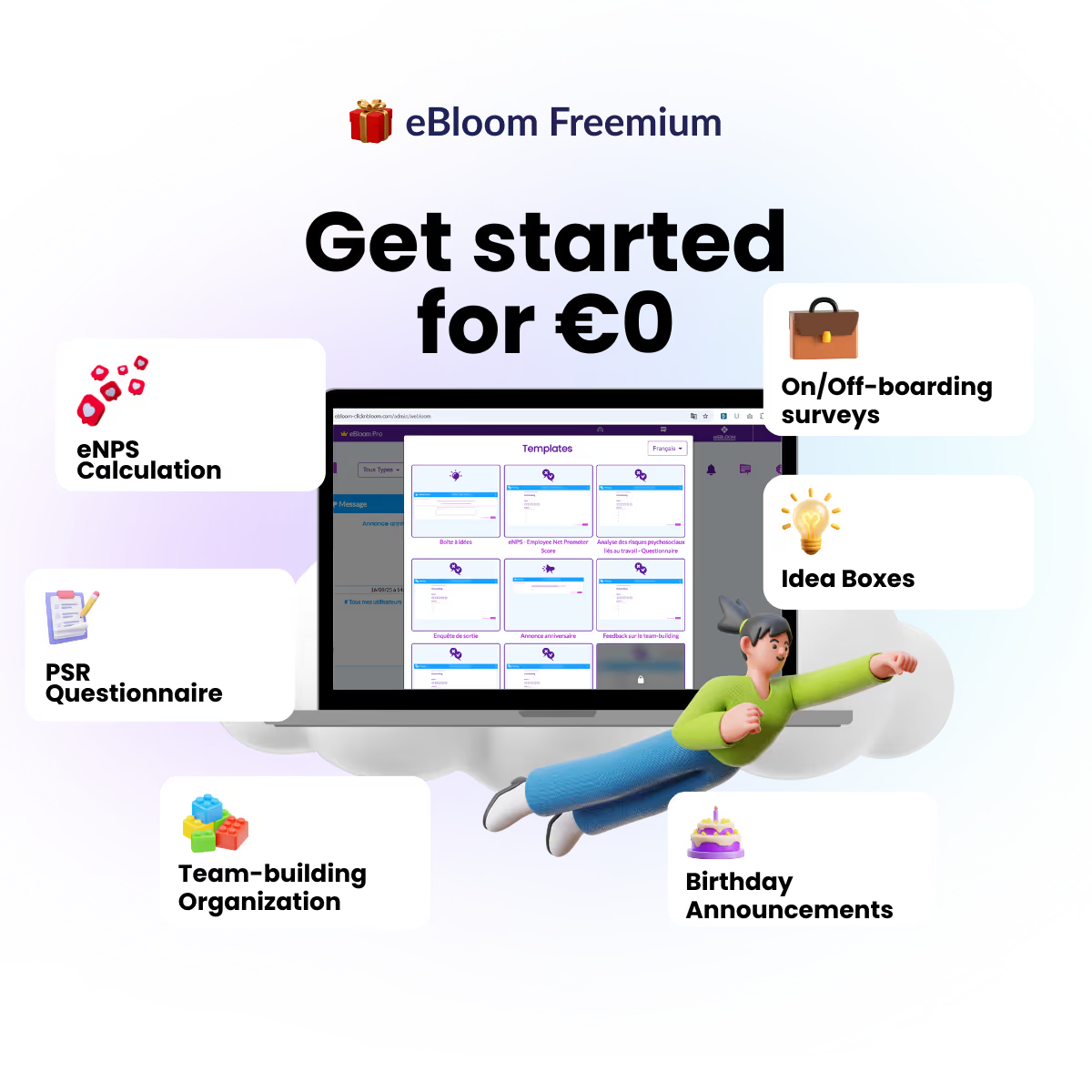
Ready to put these ideas into practice? Our Freemium plan gives you the essential tools to listen to your team and build a stronger culture. Launch targeted surveys, activate an idea box, and celebrate successes, all for €0.
eBloom Freemium promotion with a laptop showing templates, surrounded by feature icons including eNPS Calculation, PSR Questionnaire, Team-building Organization, On/Off-boarding surveys, Idea Boxes, and Birthday Announcements.
Is your company truly resilient?
Assess the 5 pillars of your resilience (human capital, agility, etc.) for free. Identify your strengths and discover actionable steps to strengthen your organization in the face of change.
Laptop displaying a webpage titled 'Assess your company's resilience' with a cartoon figure flying beside it over a cloud.
From Nostalgic Leader to NextGen Leader – Get the Must-Read Leadership Guide
The workplace is evolving—are you evolving with it? Leader NextGen by Margot Wuillaume is the ultimate guide to adapting your leadership style, engaging new generations, and retaining top talent in a changing world.
‍In this book, you’ll discover:
Check - Elements Webflow Library - BRIX Templates
The 4 major workplace transitions shaping leadership today
Check - Elements Webflow Library - BRIX Templates
How to engage and retain young talent for long-term success
Check - Elements Webflow Library - BRIX Templates
Actionable strategies and real-world examples to elevate your leadership
Check - Elements Webflow Library - BRIX Templates
Now available in French – Start your transformation today!
Master the Art of Talent Management in 2025 – Watch the Webinar Replay
Presentation slide titled Leadership & Management NextGen, with the subtitle mastering talent management in 2025, speaker Margot Wuillaume shown in video inset, dated Dec 2024.
This webinar is designed for future leaders and managers. Learn the latest strategies in leadership and talent management to excel in a constantly evolving world. Discover how to attract and retain key talent within your organization. Don't miss this enriching replay, packed with real-world examples and practical advice!
‍
‍Key topics:
Check - Elements Webflow Library - BRIX Templates
Feedback Culture
Check - Elements Webflow Library - BRIX Templates
Participative Management
Check - Elements Webflow Library - BRIX Templates
Digital Transformation
Check - Elements Webflow Library - BRIX Templates
Dynamic Leadership
Check - Elements Webflow Library - BRIX Templates
People-Focused Leadership
Check - Elements Webflow Library - BRIX Templates
Attraction and Retention of Talent
Watch the Replay - 2026 "Return to work" Reform
Missed our live session on the new Belgian legislation? Catch up now to protect both your budget and your talent. Learn how to transform a legal constraint into a performance driver.
‍
‍Key topics:
Check - Elements Webflow Library - BRIX Templates
30% Solidarity Tax
Check - Elements Webflow Library - BRIX Templates
Reintegration Mandates
Check - Elements Webflow Library - BRIX Templates
Early Warning Signs
Check - Elements Webflow Library - BRIX Templates
"Re-boarding" Strategy
Check - Elements Webflow Library - BRIX Templates
ROI of Prevention
Build a more resilient culture
Understand the 5 essential pillars and the strategies that enable teams to thrive sustainably in the face of uncertainty.
Cover of a white paper titled 'The virtuous circle of business resilience' with the eBloom logo and a blue spiral design, dated August 2025.
Measure your eNPS for free
With eBloom, every eNPS score becomes an opportunity for listening, dialogue, and transformation.
Net Promoter Score scale with emoticons from 0 (detractors, red sad faces) to 6 (yellow neutral faces), 7-8 (passives, light green smiling faces), and 9-10 (promoters, dark green happy faces) with a small rocket taking off from the right side.
Missed the Live Webinar? Watch the Replay
See how HR & AI adoption really stacks up in Belgium, and get concrete levers from Pierre Baron (CPO, Yago) to lead the transition in your own teams.

Download the 2024 Market Research

Related articles

From Nostalgic Leader to NextGen Leader: Being an Engaging Leader in a Changing World

January 26, 2026
Read the article →

Top 10 Leadership Lessons for CEOs: Insights from Successful Executives

January 26, 2026
Read the article →

Executive Team Lessons From Spotify: The Ultimate Guide To Building A Powerful Leadership Crew

January 26, 2026
Read the article →