.avif)


In the life of a scale-up, there is an invisible but formidable tipping point: the transition from a "small group of enthusiasts" to a structured organization of over 50 people. At this stage, the company culture, which previously relied on natural proximity and hallway conversations, inevitably begins to crumble.
The danger for the leader? Becoming a mere passenger in a growth process they no longer control. The risk is "flying blind," with eyes fixed on financial indicators that remain desperately silent on the real state of team engagement and cohesion. To navigate this phase successfully, instinct is no longer enough. Leaders who succeed in growing their companies sustainably transform intuition into a system. They install communication and connection rituals that act as essential safeguards.
Here are 6 field-tested rituals to channel your hyper-growth and keep your hands on the wheel.
The primary driver of disengagement in a scale-up is the feeling of becoming a mere "task executor." When the workforce doubles, the strategic "why" often gets lost between the CEO's office and the field. To counter this, establishing a monthly debrief is a powerful lever.
The goal isn't a two-hour PowerPoint presentation, but a transparent 30-minute session. The CEO shares key figures, even the most sensitive ones like burn rate or the sales pipeline, and, most importantly, the three priorities for the coming month. By understanding the direction, every employee, from developer to technician, finds meaning in their daily tasks.
In the scale-up phase, a founder's intuition, however sharp, eventually meets its limits. The CEO can no longer be everywhere, and what they sense in the cafeteria is often just the tip of the iceberg. To avoid being surprised by a wave of resignations or an unexplained drop in productivity, successful leaders have established a ritual of management through human data.
Concretely, this ritual involves integrating a systematic social "weather report" into every Executive Committee (ExCo) meeting. Instead of relying on impressions, leaders analyze engagement indicators updated in real-time via regular team feedback.
The benefit? Obtaining a clear and nuanced vision of your team dynamics. This allows for the management of essential indicators such as mental workload, culture alignment, or management quality, while also detecting more subtle signals, such as mental distancing. By objectifying these feelings, the ExCo can make fact-based decisions. If a department shows a satisfaction score in freefall, the CEO sees it immediately and can intervene in a targeted manner before the bond breaks. This is the transition from crisis management to preventive management, where the "human" is tracked with the same precision as the cash flow.
As an organization grows, top-down recognition mechanically becomes rarer and less precise; a CEO can no longer see every line of code or every successful client call. To maintain the "social glue," you must stimulate informal recognition and make gratitude horizontal.
A "Thank You Ceremony" (or a Slack/Teams channel dedicated to "Kudos") radically transforms internal culture. By encouraging every team member to publicly thank a colleague for specific help, you value the behaviors that constitute your true identity.
The concrete example at eBloom: At eBloom, this culture is anchored in daily life via a general discussion channel accessible to everyone. This is where the magic happens:
The business benefit: This ritual allows departments that no longer cross paths physically to stay bonded around common values. You don't just celebrate a number; you celebrate the collective effort that made it possible to reach it.
Nothing is more destructive to trust than asking for employee feedback and never following up. To avoid this pitfall, scale-ups that maintain high engagement have established a ritual of co-construction: moving from diagnosis to shared action.
The idea is to use themes raised by regular feedback as a basis for brainstorming sessions, whether through live workshops or a digital suggestion box. Instead of deciding alone in an office, the leader invites teams to propose concrete solutions to improve the organization. Once these paths are sorted and prioritized, leadership communicates transparently: "We heard you; here is what we’ve selected, what we are going to implement, and what we cannot do right now."
This rigorous method is what allowed Bemac to finalize nearly 20 concrete HR actions in a single year. By openly explaining these trade-offs, you don't just manage processes; you prove to every talent that their contribution truly influences the company's future. This ritual transforms anonymous feedback into a motor for collective innovation.
In hyper-growth phases, internal promotion is often the rule: the best technical experts are naturally propelled into management positions out of organic necessity. However, being an excellent developer, engineer, or creative does not prepare one for the complex soft skills required for management: conflict mediation, delegation, active listening, or constructive feedback.
Without specific training for these human challenges, these managers often find themselves "between a rock and a hard place," exposed to record-high stress levels in 2026. To protect this organizational backbone, two levers are essential:
The core idea: Investing in your managers is not just a matter of wellbeing; it is securing the transmission of your vision throughout the entire company.
In the heat of acceleration, the major risk is that relationships between managers and employees become purely transactional, limited to daily emergencies. To counter this drift, high-performing scale-up leaders impose a non-negotiable ritual: the monthly individual check-in.
The idea is not to do a status update on projects, but to create a 30 to 45-minute exchange bubble dedicated exclusively to the employee. The manager takes on a coach role rather than a controller role. They discuss feelings, mental workload, and development perspectives. For middle managers, this regular appointment is the best prevention tool. It is by listening to aspirations and friction points every month that you avoid mental distancing, that silent psychological withdrawal that often precedes resignations or burnout. By objectifying these moments through regular tracking indicators, the CEO ensures that the organization's backboneits managementremains solid and human despite the pressure for results.
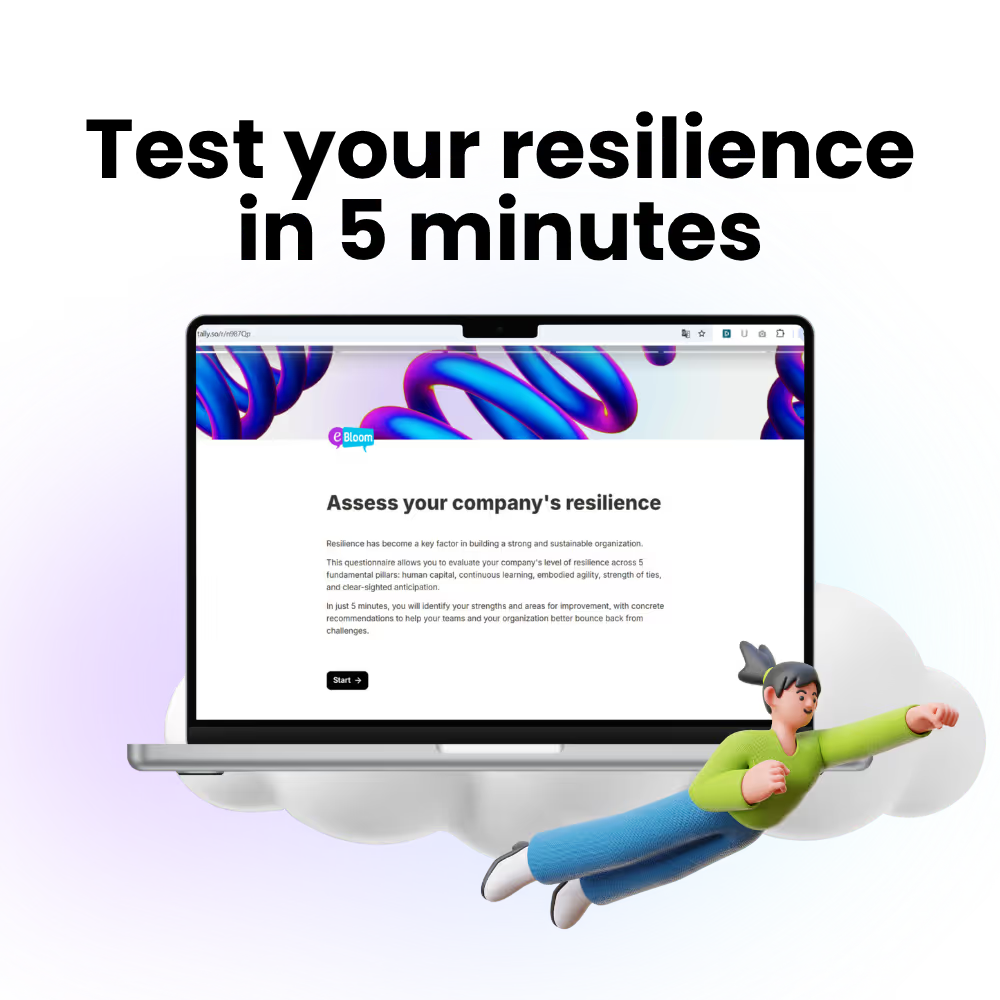
You are ready for growth, but is your culture ready to scale? Take the 3-minute test.


From HR digitalization to AI integration and new employee expectations, the human resources sector is rapidly changing. Based on responses from over 450 Belgian companies, our report gives you a head start to prepare your teams and strategy for the realities of tomorrow.
.jpg)
.avif)

.avif)



.avif)

.jpg)